cheap gucci shoes jordans shoes cheap jerseys mbt扑亙奈朮 ugg classic tall ghd styler iv timberland boots sale
image

image
image

learn to fly

T H E  R E A L  A L T E R N A T I V E  T O  A I R C R A F T  O W N E R S H I P

Take Flight Aviation Limited at Wellesbourne Mountford Airfield in Warwickshire offers you a Private flying club with unrivalled facilities, providing its members general aviation aircraft hire without the limits imposed by many flying schools, the hassle associated with flying groups or the financial burden of ownership.

touch the sky


member log in


C H E C K  O U T  H O W   M E M B E R S H I P   C O U L D   B E N E F I T  Y O U !

Our resident Instructors and Examiner are on hand for flying lessons plus advanced VIP PPL (Private Pilots Licence) training, advanced instruction, night and IMC ratings, flight reviews and skills tests, or to check you out on club aircraft. As well as social and training activities as a member you'll enjoy the use of modern pilot lounge facilities and preferential aircraft hire rates, leaving you to fly and enjoy great aircraft as if it were your own!

For more information or to Join our email newsletter "FlightLines" click here.

T H E  F R I E N D L Y  F L Y I N G  C L U B !    S E E  W H A T  Y O U  A R E  M I S S I N G  H E R E   >  >  >

Getting Private Pilots Airbourne at a Fraction of the Cost

When most private pilots learn to fly, there can be a few limitations to taking advantage of their new licence. The cost of aircraft ownership can be out of reach for some, whilst hiring from flying schools involves vying with instructors and students for a slot.

We provide the answer. By joining our private aviators club, current licensees can enjoy aircraft hire with no daily minimum hours requirement. This means you can hire aircraft for a day, a weekend or a week and only pay for the hours used.

Based at Wellesbourne Mountford Airfield in Warwickshire, our club boasts facilities that are second-to-none. If you've made an investment in your own aircraft, you can benefit from full use of the VIP lounge facility, which boasts leather sofas, internet access, TV and DVD. You can choose sole use of this facility at a discounted rate or choose full membership that entitles you to access club aircraft. Either way, you can plan trips, fax flight plans, check the latest weather online and meet like-minded members in social events and fly-outs.

We also offer instruction, which costs £30 per hour for Advanced Night, IMC or PPL in addition to Aircraft Hire Rates. Trial lessons and gift vouchers are also available. All examiners and instructors are CAA (Civil Aviation Authority) registered.

So if you are looking for a flying school without restrictions and hidden charges, the sky's the only limit!


              takeflightaviation logo                                       

                                                          The Midlands Premier Aircraft Hire and Flying Club

   Wellesbourne Mountford Airfield  -   Wellesbourne  -  Nr Coventry  -   Warwickshire   -   CV35 9EU     Tel: 01789 470424


Site Map

Flying Lessons - All our instructors are professional pilots ready to pass on their knowledge to you.

      aircraft hire l owner facility l private aviator club l latest news l vip lounge l faq l gallery l learn to fly l gift vouchers l contact us l links l caa


Whilst I have always sold Take Flight on the ethos that ※we're not another flying school§, you will have noticed over the few months a raft of freelance instructors joining the ranks. It seems that PPL students like the Take Flight approach and can see the benefits of membership not only with our fine band of enthusiastic instructors but in addition the benefits the club offers when they have their PPL and want to use it.

January 2009


Despite our growth in instructors, students and new members over 2008, aircraft utilisation in particular for G-BYSP is still very low and we still have room to expand our membership with the current fleet. Obviously the more the aircraft flies the more the fixed costs are distributed between the hours, which keep our rates down. Believe it or not and I'm happy to share the figures with you, our member hire rates for club aircraft, starting at less than £100 wet for a PA-28, are still no more than the actual true cost of operating the aircraft.

Although fuel rates appear to have stabilised for the time being (and you will have noted the lack of fuel surcharges last year) maintenance costs have continued to rise not helped by various new regulations. Therefore it is inevitable that there has had to be a small price increase in hire rates for 2009, but if your flying is ※price lead§ please take advantage of our special offer. I'm willing to let you pre pay as many hours as you may wish to use in 2009 at the old rates for payments received in January. Our hourly rates are still the most competitive around
with the membership benefits of ※aircraft hire without limits§ USP. The membership and fleet continues to grow in 2009. One new member recently said we were not only the most competitive he had found, but we also had the best people, aircraft and clubhouse. I knew that already but thought I'd share it with you in case you'd forgotten!

Welcome to the 2009 member briefing. Before the latest offering of wit and wisdom from our CFI John Eburne, a few paragraphs from me.


Take Flight continues to go from strength to strength and whilst the economy is in decline it seems many more people are seeing the benefits of joining us at Take Flight Aviation. Sierra Papa often doesn't fly from one weekend to the next. We are still keeping to our rule that only one aircraft per day is allowed to be block booked for instruction, which means there should always be at least one club aircraft in addition to the Cherokee 6 for members to fly. We are also hoping to add a members aircraft to the hire fleet soon, stay tuned for more details as I used to say!

May I also remind you to cancel your booking on e-allocator if you're not flying. Just because you may have given up on your plans due to poor weather or the wife's shopping trip, it doesn't mean that someone else may not want to go flying and even in less than perfect weather, to use the aircraft for some circuits or go IMC!

SP has had a new interior in a two tone grey and looks fantastic. A new propeller was also fitted as part of its annual service in December and Mode S is next on the list ready for some exciting international fly-outs in 2009. Please look after the interior, watch where you're putting your biros and map markers. Also, with the new paints jobs on SP and VS in the last twelve months, take care were your doing power checks to protect the prop and paintwork. It would also be nice to see seat belts left neatly for the next pilot, in fact generally leave the aircraft the way you'd like to find it and if you're taxing past the fuel bay it would be courteous to fuel the aircraft at least to tabs if it's got less than a couple of hours left in the tank.

It was great to see so many people at our Christmas party event at Hanger One in Sywell. It seems a long time ago although only a couple of years that our Christmas event was for twelve in the back room of some long forgotten pub in Hampton Lucy! The Memphis Bell Orchestra were great and if only my winnings in the Casino had been real (see picture for details) we'd have a new fleet on order. If you didn't make it hope to see you at the next one!

A party of 6 of us took the PA32 to Le Mans at MAUW. The journey time brakes to brakes were 2 hours 10 minutes. For those who have not been to Le Mans before it's slightly larger than Wellesbourne but not so much as to be difficult to get about. As is usual in France a courtesy bus comes to collect you from the apron. For the duration of the 24-hour race they have full customs clearance. In terms of convenience and by way of comparison, the back of the main grandstand would be about where the factory units are at Wellesbourne. It's pretty convenient if endurance racing is your bag. We have other motor racing centred trips in the pipeline for next year. If anyone is interested please make yourselves known. Monaco perhaps?

Birmingham Zone


On the subject of zones, Birmingham has launched a new squawk code, which is 0010 with mode C if possible. Displaying this code means I am listening to Birmingham Approach on 118.050, but not talking to you. This arrangement suits Birmingham's controllers just fine. Bit like Claire after I get in late from night flying! Peter Taylor has organised a successful evening visit to Birmingham Tower recently and has others planned as they can only take six people at a time. The controllers stressed they will always help if you need it and allow zone transit if they can, but have a pretty high work load to be much assistance outside the zone so welcomed our visit and understanding of the new squawk.

Brize Norton


Peter also arranged a daytime trip earlier in the year to the Brize Control Tower. All who flew in enjoyed this and we were well entertained by the controllers. For anyone who hasn't been to Brize before it was an eye opener as to how small the team is that controls such a large zone and their plea was that for zone transit use 119.00 or for FIS use 124.275, but they are not being rude if they don't answer on FIS frequency as it may be the same operator using both frequencies from two separate workstations.

We also visited Coventry airport tower, again flying in and here we saw how Coventry can see aircraft leaving Wellesbourne on radar and made a plea that when flying close to them they are contacted so they can issue a squawk and at least then have some indication of who is transiting and who is landing.

Isle of Wight

This trip was scheduled for Lands End/Scilly isles but with bad weather all down the west coast we diverted to Bembridge for the weekend with an excellent meal in Cowes.

Dublin


The annual trip to Dublin flying into Weston airport, was well attended with a super meal and live music at Oliver St John Gogarty's and after a few hours of lubrication, the crew was last seen hailing a horse and carriage at 3.00am looking for the hotel!

Vulcan day BBQ
The annual Vulcan fast taxi run at Wellesbourne was well attended by members and friends with Mike providing an excellent Barbeque


Notes from our CFI

IMC Ratings


Congratulations are due to Pete Treble in completing his IMC course recently. Gordon Smith is well on the way with his IMC rating too and will soon join Pete as another PPL with extended privileges.

Congratulations to Clark Stanley who completed the first, ※first solo§ of the year on the 3rd January 2009 with a silky smooth landing with just 10 hours instruction from Ali. Clark who is aiming to complete his PPL in the next month with intensive instruction looks on target to be our first PPL of 2009 although Sam Iska who is completing his PPL after joining Take Flight from another regular school is also a keen contender.

Night Qualification


Once again well done to Pete Treble and also Paul Meakin for completion of their Night Qualifications. We are hoping to get another couple in this season as well, so a celebration Night flight to Leicester for curry looks in order!

Safety Issues
每 the whys and wherefores of check lists- Taking the Strain


A recent little incident happened to me whilst trying to night fly that I thought I would share with you. From such things we learn. In a member's private aeroplane, we started off for the hold on a particular night detail and there ran through the usual power checks. Everything appeared normal until the idle check at the end of the power checks. At this point the engine stopped. We tried to restart and eventually got the aeroplane going and taxied back to parking for a closer look. On inspection the right tank was feeding fine which we had initially taxied out on. The left tank, which we switched to for the power check, was found to have 1 litre of water in the fuel. This was drained off by maintenance and signed off as fit for flight. A further inspection two days later showed at least another pint of water in the left tank. Yes the weather had been very wet but the seals on the tank were suspected of being a poor fit. Remedial action is now in place.


This was a night detail so the consequences of getting airborne on the good tank and switching to the contaminated one in flight would have brought a whole host of new challenges to us. Always follow your checklist, it's written in a particular order to seek out these problems. Always purge fuel lines prior to flight and always carry out a thorough fuel check. If it looks like fuel, smells like fuel and even tastes like fuel it might be the genuine article. If it's clear it isn't. In the owners defence I would doubt many of us would expect to drain off a litre of contaminant by torch light in the dark. I note that this months Gasil has a similar incident described in it. It's not the dramatic once in a lifetime developments that you need to guard against but the everyday little issues.


They are the ones guaranteed to cause you a bigger problem later on.


Engine Failure Drills


When I am conducting peoples Biennial Flight Renewals PFLs are the area most likely to lead to a variety of styles from a potentially survivable outcome to an uncontrolled crash. Invariably I am given a running commentary about ※What I'd do if this was real§. Well folks it's as real as I can make it, or want to get with it. I don't really need the commentary and it takes up loads of your brainpower too. Just ask an instructor how hard it is to fly and talk. We have to go on special courses to learn how to do that and then periodically, the CAA test us to see if we can still do it! There are at least 64,000 ways of pulling off a PFL here's the one I use because I think its simple. I need to make a small confession here. I've been shown all this high key/low key stuff and also the constant aspect angle method. Be honest have you ever seen that constant angle 每I haven't.


Simply put when the engine stops or looses power convert your speed to height and turn down wind. Put the wind direction on the bottom of your DI. Now trim for the best glide speed. Pick your field it will be somewhere between the wing tips spinner and tail so pretty well below you. Ideally with a pleasant up slope of dry grass, no cattle or standing crops and a country pub at the end of the lane would be nice, but in reality it will be Hobson's choice.


Now you can get on with your fail checks. Significantly is it on fire or not, and then close down if you can't restart it safely. I should add here that if you are only practising don't touch anything that might actually stop the engine, many a realistic drill has turned in to the real deal through over exuberance. You are now committed so let someone else in on the secret with a Mayday call. The Mayday needs to be in plain English 每 roughly where you are how many on board and your intentions. Trust me any aircraft on frequency in the vicinity will make a bee line for you. (Incidentally if you are one of these aeroplanes keep a good look out I bet you won't be the only one). Brief your passengers about opening doors removing false teeth spectacles and sliding their chair away from all the sharp bits of metal poking out of the instrument panel. No crumple zones or air bags here. Squawk 7700. Check your height relative to the field and plan a circuit fairly close in. Remember the first thing you did was to turn down wind so all you now need to do is turn back in to wind for your chosen field. Wait until your nose covers your aim point halfway in to the field than take full flap and drive the aeroplane down at approach speed. S Turn or orbit if you are too high. If you are on the low side cut the corner on to finals and leave flap until you are certain of making your aim point. Its better to slew through the far hedge at 20 knots than arrive at the first one at motorway driving speed. When you land exit the aeroplane and keep well away from it and call for help.


What happens if you are low level when this happens? Turn across wind and a promise the field will present itself on one side of the nose or the other. If you are on fire close down quickly and you will need to pull off the best sideslip you have ever carried out to basically beat the flames down to the ground before they can affect the structural integrity of the aeroplane. Sorry there I go again getting all serious about this. If any one wants a refresher please let me know.

REVIEW OF FLYING EVENTS JUNE 2010

Airshows can and do change your life.

Steve Bridgewater reveals how a trip to an airshow as an aspirational nine-year old moulded his life.


I remember straining my neck to look into the far distance. An unmistakable shape was circling on the horizon, a shape this fresh-faced nine-year old had seen in books and magazines, but never seen in the &flesh.*


But it wasn*t time just yet. High in the sky above RAF Cosford nine red jets spiralled and pirouetted their way between the clouds, their coloured smoke painting a trail and smelling divine as it drifted down onto the crowd.
The jets arched over the top of a loop and speared straight down towards the earth... ※Ladies and gentlemen...§ said the commentator, adding a dramatic pause as the aeroplanes dropped ever-lower, ※I give you the Royal Air Force Aerobatic Team for 1984... the Red Arrows!§ Seemingly at the last moment the jets split in nine directions and tens of thousands of people applauded and cheered. In front of me a small aeroplane burst into life belching a cloud of oily smoke behind. Its silver fuselage and yellow wings glinted in the dappled sunshine.


But this young boy*s attention was drawn back to the horizon, the incoming aeroplane was now trailing a cloud of thick black smoke and flying straight towards the airfield. The mighty Vulcan bomber was inbound. At crowd centre the pilot stood the big delta onto its tail and the engines howled as it climbed towards a large blue patch in sky. For the next 15 minutes I stood spellbound as the V-Bomber cavorted in front of me, a wide eyed grin seemingly painted onto my young face. This was 1984, I was just nine years old but I remember my first airshow experience to this day. I*d always been interested in aeroplanes but that day, more than 25 years ago, I knew I wanted to be a pilot.


Airshows do that to a young child. They enthral, they energise an active imagination and they inspire. Ask almost any aviator and they will tell you that a childhood airshow experience was instrumental in their decision to work in aviation.


This year marks the 100th anniversary of both the world*s first airshow and the first aviation meetings in Great Britain. The century has seen British airshows firmly establish themselves as the biggest, best and most famous in the world. In 2009 the British airshow scene is the healthiest in the world. Attendances top 6.5 million 每 making it the second largest spectator event in the country, second only to attending football matches.


Airshow attendees in this country also have the widest choice of venues (per capita) and the biggest variation in airshow genres. There are events tailored for those who are passionate about modern jets, shows specialising in restored World War Two aircraft, aerobatic contests and fly-ins of general aviation aircraft. There are tradeshows for helicopters, microlights, light aeroplanes, kitplanes and of course the SBAC Farnborough show remains the best regarded aviation trade show in the world. However, perhaps more importantly, there are shows that feature a mix of all these genres 每 offering something for everybody. These shows offer much more than aeroplanes, they include funfairs, markets, craft stalls and all manner or attractions to appeal to the entire family. It is perhaps these shows that do the most work at inspiring the next aviation generation. The largest growth area in recent years has been the boom in seaside shows. Local authority funded shows are now commonplace at cliff top and beach venues around the coast of Britain from Dawlish in the south to Sunderland in the north. The massive shows at Eastbourne and Bournemouth attract hundreds of thousands of spectators, many of whom would never consider visiting an airfield to watch aeroplanes.


British airshows do an immeasurable amount of work. They inspire young and old alike. They highlight the
technological wonders created by the British manufacturing industry and pay tribute to the brave men and women of our armed forces. They enable us to commemorate the past and pay our respects to fallen heroes. Airshows also attract such huge attendance figures, which in turn play a massive part in the British economy with people from around the country (and the world) needing hotels, food, fuel and other services in the show*s catchment area.


Since my indoctrination some 25 years ago airshows have become a way of life. As a teenager I spent almost every summer weekend on an airfield watching my heroes fly in the skies above me. In my early 20s I found a job that enabled me to convert my passion into a career and I have spent the last ten years reporting on airshows as an aviation journalist.


Having finally overcome a medical &issue* I gained my pilot*s licence in 2005 and am actively pursuing my goal of becoming a display pilot. It is my hope that I will one day be able to play my own small part and help inspire a child in the same manner as my eyes were opened on that June day in 1984. Airshows determined my path in aviation, and resulted in a career that I dearly love. For me airshows are important in so many ways and the centenary of the inaugural event was an obvious choice for my third entry into the Dawn to Dusk competition.
Blackpool 1909 Fairford 2009

Background

I first found out about the annual Dawn to Dusk competition in 2005 when I was working as Deputy Editor at Today*s Pilot magazine. One of my contributors sent in an article about his entry 每 detailing how he had flown a flexwing microlight from Lands End to John O*Groats to raise money for charity 每 and he had clearly had a lot of fun. At that time I was approaching the end of my National Private Pilot Licence (NPPL) and looking for ways to use my new licence. Through my friendship with Polly Vacher I had also become involved with the Flying Scholarships for the Disabled (FSD) charity and I decided to use my Dawn to Dusk entry to benefit FSD. Using the 70th anniversary of the Supermarine Spitfire as our theme Louise Walker and I set off early on June 29, 2006. At that time I had just over 80hrs total time and just 18hrs in command. Louise and I landed at 14 former Spitfire airfields during the day, covered 617nm and flew for 8hrs 35mins. Our entry was judged to have come third and was awarded the Tiger Club Trophy but we also raised around £3,000 for Flying Scholarships for the Disabled and generated a mass of publicity.

Having been &bitten by the bug* in 2006 I decided to enter again in 2007. By this time I had formed a longstanding flying partnership with Amanda Harrison and our mutual love of 1920s aviation and air racing resulted in us marking the 85th anniversary of the King*s Cup air race. By now I had logged 118hrs and I clocked up my 50th hour in command during the flight. We flew our 2007 entry on July 27 and by the end of the day we had reached 14 former King*s Cup race venues. We had flown 712nm and been airborne for 9hrs 05mins (10hrs 35mins &chock to chock*) by the time we landed back at our base at RAF Brize Norton.

Our 2007 flight resulted in yet more publicity for Flying Scholarships for the Disabled and was awarded both the Tiger Club Trophy and the Pooley Sword by the judging panel. The following year saw Amanda working as a newly qualified Flying Instructor and I had just formed my own company, having been made redundant. As such we were unable to fund the flight ourselves and we had little available time to find a sponsor. Regrettably we were therefore forced to sit-out the 2008 contest.

Amanda and I are both keen advocates of Dawn to Dusk as a method of expanding a pilot*s aviating horizons. All too many pilots allow their licence to lapse due to a lack of motivation or reason to fly, but we try to explain that Dawn to Dusk gives them that reason to fly. We both actively promote the contest through lectures at flying clubs and aviation societies around the UK and Amanda extols the virtues of the contest to the many student pilots that pass through her hands each year. We have also published articles about our flights in Today*s Pilot, Pilot, Go Flying, the Guild of Air Pilots & Air Navigators magazine and the magazine published by the British Women Pilots Association.

At least two teams of pilots have entered the Dawn to Dusk contest this year as a result of the promotion we have been doing. They are both dear friends and we have offered them as much advice and encouragement as possible, but that only made us more determined to enter ourselves and give them a run for their money!

Dawn to Dusk 2009

My love of airshows recently combined with my publishing background and early in 2009 I was commissioned to write the definitive history of British airshows. With the research into the book progressing well it became obvious that the Airshow Centenary would make an ideal theme for a Dawn to Dusk entry... all we needed was a sponsor. The current financial climate did not help matters and our former sponsors wished us well but sadly could not offer any assistance. By now my company, Awyr Aviation Communication 每 which specialises in marketing and promotion work for aviation companies 每 was building its client base and a number of companies were cajoled into giving the project consideration.

Despite a false-start with Air Atlantique*s Classic Flight, who expressed interest but was eventually unable to help, we pressed on and a new customer sprang to the rescue at the eleventh hour. Take Flight Aviation employed the services of Awyr Aviation Communication in July 2009 and on July 17 pledged to fully sponsor our Dawn to Dusk flight as long as we could guarantee publicity in one of the major General Aviation magazines.

As both Today*s Pilot and Pilot magazines had already included features about the 2006 and 2007 flights respectively we decided to offer the rights to the third flight to Flyer magazine. Discussions with Ian Waller, Editor of Flyer, were instigated and July 21 he confirmed he would commission a major article about our flight. Take Flight Aviation*s owner, Mike Roberts, gave us the go-ahead to start preparations immediately and the race was on to make the competition*s impending deadline.

Take Flight

Take Flight is a novel concept among flying &clubs* and actually has more in common with an aircraft syndicate or fractional ownership scheme. Take Flight members enjoy aircraft hire without limits. There's no minimum hours requirement, which means you can hire aircraft for a day or a weekend, but only pay for the time the aircraft is in use.

It's like having your own aircraft to use as you wish, but at the fraction of the cost of ownership! Unlike most flying schools and training organisations whose emphasis is training, Take Flight focuses on pilots who want clean and reliable aircraft to fly without restrictions, whenever they want them. The monthly fixed cost to members is £40 per month then pilots pay per hour flown. Members can fly as little or as much as they like. No minimums - no maximums.

Student PPL's pay half price for the duration of training. The hire rates 每 typically £89.00 for a PA- 28-140 on a weekday includes fuel, VAT and home landing fees at Wellesbourne Mountford.

Change of Charity

As one of our friends was already entering the 2009 Dawn to Dusk contest on behalf of Flying Scholarships for the Disabled we decided to use our flight to benefit another charity. We felt that the general media would be less willing to offer publicity to &another aeroplane* raising money for &the same charity* so opted for a different stance. In 2006 my first entry into the Dawn to Dusk contest received sponsorship from Shepherd Neame brewery, brewers of Spitfire Ale. Among their package of support was a media launch event at Biggin Hill, to which the media, supporters and friends were invited along with representatives of the Flying Scholarship for the Disabled charity. Among the people I met that evening was a wonderful young lady by the name of Mandy Pantall. Mandy had enjoyed an incredible life, being a competitive gymnast, ballroom dancer and horse rider. She had also worked as a &wingwalker* standing atop the wing of a Boeing Stearman biplane sponsored by the Cadburys Crunchie Flying Circus and had the world at her feet. Then, ten years ago a horse riding accident left Mandy unable to walk without grave difficulty and in chronic pain at all times. In 2006 she was the recipient of a flying scholarship and on the day of my Biggin Hill press launch she flew a Piper PA-28 in from Goodwood with her instructor.

To this day I remember the moment I met Mandy. She climbed from her cockpit and with the aid of two crutches she walked across the Biggin Hill apron to greet me. ※Hello,§ she said, ※I*m Mandy and I*ve just gone solo today!§ She then promptly burst into tears and flung her arms around me. We all remember our first solo fondly but for somebody who has been through so much as Mandy the emotion of such a landmark was too much to keep hidden. From that moment Mandy became a very dear friend. In fact she became the nearest I have to a sister and I love her dearly. It was a proud day for us all when Mandy passed her skills test and qualified as a fully trained pilot. She is one of the best aviators I know, precise, safe and cautious but she enjoys every second she is in the air. Amanda met Mandy independently through the British Women Pilots Association and was equally in awe of her willpower and determination as well as her infectious personality and drive for life. Mandy benefited from her scholarship in so many ways and she was eager to return the favour. In late 2006 she was approached by Rolls Royce*s Chief Test Pilot, Phill O*Dell (POD), who asked her to join him in establishing a new charity at Kemble.

This would become known as the fly2help Foundation. The duo are seen here with F1 World Champion, and fly2help supporter Lewis Hamilton. fly2help - Turning Ordinary Days into Extraordinary Adventures.

The fly2help Foundation is an exciting charity that lifts people*s horizons via the medium of flight; working with individuals, groups and like-minded charities to stretch physical, mental and emotional boundaries that have been set by a life trauma or tragedy. The charity*s core focus is disadvantaged youngsters for whom they aim to inspire imagination, determination, self-esteem and confidence. However fly2help is committed to supporting anyone who could benefit, regardless of age or circumstance, typically supporting the terminally ill, chronically sick and bereaved.


In addition, there are those who simply need a life boost; including those who have suffered extreme neglect and abuse, and those who face exclusion from society on a regular basis as a result of mental ill-health, sickness, disability, injury or financial deprivation. Central to the beliefs of fly2help is that offering an exhilarating flight and enabling someone to reach for the skies gives them the chance to see the world from a whole new perspective, both literally and metaphorically. For someone less-advantaged, just being able to wake one morning with a sense of achievement or excitement, rather than disappointment, can be an enormous step towards recovery. fly2help*s goal is to share blue skies, adventures and smiles; creating precious memories for those who need them most.

fly2help*s educational wing encourages youngsters to reach their full potential through educational programmes run in partnership with schools or community groups; also offering flying scholarships, fostering and mentoring those who have a thirst for a career within the aerospace industry. Having seen firsthand the difference that fly2help makes to so many lives Amanda and I decided to use our 2009 Dawn to Dusk entry to benefit this amazing organisation.

Crew Members

Two members of crew were carried on the Dawn to Dusk flight 每 sharing the flying equally between them. Amanda Harrison Amanda obtained her pilot*s licence in 2001, her night rating in 2005 and her Commercial Pilot*s Licence (CPL), Multi-engined Instrument Rating (IR) Multi Crew Co-operation (MCC) rating and Flying Instructor rating in 2007. She was born in the Nottinghamshire but travelled around a lot as a child before her family settled in the Lake District. She now lives in Brize Norton in Oxfordshire. She has spent the last two years instructing in various aircraft but has become a specialist in the glass-cockpit equipped Cirrus range of light aircraft. Amanda has recently accepted a job with charter company PropStar at Kemble airport. She has recently completed her conversion onto the Piper Seneca and has been signed off as &Pilot*s Assistant* on the Beech King Air. She has also converted onto the Tiger Moth and hopes to begin instructing on the type very soon. Before she flew for a living Amanda enjoyed a varied career with jobs ranging from photography and television production to dance teacher and prison warden. In her spare time she looks after injured birds of prey. In September 2006 she competed in the 75th anniversary Schneider Trophy air race at Bembridge on the Isle of Wight. Racing a Cessna 182 she finished 26th overall and was the fastest female competitor in the race. She had previously been the Assistant Aviation Secretary for the Royal Aero Club Records, Racing & Rallying Association and has navigated in several air races.

Amanda was diagnosed with Dyslexia at a young age yet has pursued her passion for aviation and become a commercial pilot despite this obstacle. She prints her PLOGs and other in cockpit paperwork on yellow paper and finds this helps her to read it in flight. Amanda has flown around 1,300 hours in an assortment of types and was born to fly! She was elected as a Freeman of the Guild of Air Pilots and Air Men (GAPAN) in 2007 and is an active member of the British Women Pilots Association (BWPA).

Stephen Bridgewater

I have held a National Private Pilot Licence (NPPL) since September 2005 and had logged just under 150hrs when I began this Dawn to Dusk flight. Most of those hours have been logged in Piper PA-28s and Cessna 152s but I have also flown aircraft as diverse as the Jet Provost, Extra 300 and Bulldog. I was born and bred in Tamworth, Staffordshire and have also lived next to RAF Wittering near Stamford. I now live in Nottingham where my fianc谷e is a doctor at the Queens Medical Centre. After initially failing my PPL medical due to a minor heart condition (Wolff Parkinson White Syndrome 每 Type 2) I have now obtained a JAA Class II medical. It had been my intention to sit the PPL Skill Test to &upgrade* my NPPL license to a PPL(A) but I have not yet felt that the NPPL restricts my flying sufficiently to justify the time and expense of swapping. Although trained in marketing I made my aviation career as an aviation journalist and have edited Air Action and Go Flying! magazines and been Deputy Editor at Today*s Pilot and Pilot magazines. I have been short-listed for the prestigious International Aerospace Journalist of the Year Award (AJOYA) on three separate occasions and have had work published worldwide.

I have also worked for Pooleys Flight Equipment as Head of Marketing and the Air Atlantique Classic Flight Club as Commercial Manager. I now run Awyr Aviation Communication, a company offering marketing, PR and journalism services to the General Aviation industry. I was also elected as a GAPAN Freeman in 2007 and in 2008 was asked to help create the GAPAN Young Members (GYM) organisation to promote youth in aerospace. I sit on the GYM committee to this day and have recently applied to become Liveryman of the Guild I am also a founder committee member of the Friends of Duxford (FOD) organisation (which we created in 1999) and also sit on the committee of the Tamworth Model Aero Club 每 which I have been secretary of since 1991 (when I was 16). The bulk of my time this year has been taken up researching a book marking the 100th anniversary of the first British airshow in 1909.

The Bears!

It is seemingly impossible for Amanda and I to conduct any long distance flight without the cockpit being infiltrated by at least two bears! On this occasion we welcomed aboard &Charlie* the official fly2help bear and &Ray*. The latter is my own bear, which has now flown on all three of my Dawn to Dusk flights. The name is two-fold. Firstly it is in memory of the late, great and much missed Ray Hanna 每 Spitfire maestro and airshow pilot par excellence. Secondly the name Ray also refers to the Rays of light we hope to see during the sunrise and sunsets we experience on our Dawn to Dusk flights. The bears were left on charge of provisions during this flight but in hindsight we are sure they consumed more than their fair share of bananas!

John Baker & Guy Stockley

My previous two entries have benefited from the input from an Operations Manager both beforehand and, crucially, on the day itself. We have found that an Operations Manager helps co-ordinate our day by liaising with airfields and air traffic units to advise them of our amended timings and speed our transit through their facility.

He also updates us with weather and NOTAM information as required and gives gentle reminders on food and hydration 每 which is all too easy to forget during the stress of the flight. The Operations Manager for my 2006 flight was Guy Stockley but he was unavailable in 2007 so John Baker stepped up to the mark. In 2009 they both played a vital role... even though Guy was stationed in Afghanistan!

Guy was born in Crawley, West Sussex and currently lives in Leicester. He is a newly qualified commercial pilot with a background in the RAF. He worked finished his RAF career in photographic interpretation at RAF Brampton before leaving to become an airline pilot in 2006. The slump in airline recruiting has resulted in Guy looking elsewhere for work and he is currently flying Unmanned Aerial Vehicles (UAVs) in Afghanistan on secondment to the Royal Netherlands Air Force.

John was born in London, but now lives in Lingfield next to London Gatwick airport. He gained his PPL in 2005 at Shoreham-on-Sea and has flown about 140hrs, mostly in Cessna 150/152s and Piper PA-28s, but has also flown the Piper Cub, Tiger Moth, Harvard and an AirCam amphibian. He is a Design Engineer by profession and volunteers as the Turn Point Coordinator for the Royal Aero Club Records, Racing & Rallying Association. He has also navigated in several air races.

Both Guy and John were a tremendous help in the lead up to the flight. During the flight itself Guy was enjoying a welcome &day off* in Afghanistan so he positioned himself at a computer and remained in e-mail contact with John. He kept a watchful eye on NOTAMs and weather and helped John as much as he could from afar.

Flightworx

During the flight John positioned himself in the 24hr Operations Room used by Flightworx Aviation at Earls Colne. FlightWorx provides one-to-one trip support to both business aviation and private pilots who want to travel throughout the world. This is provided on a fixed fee ad-hoc basis or fixed annual/bi-annual or monthly tariff as required. They can provide all manner of services including customs and flight planning, airfield awareness briefs, flight following, ground handling, PPR and even hotel bookings 每 thus taking the uncertainty out of long distance touring. Amanda and I are indebted to the help given by John and Guy 每 along with James Wiskin and Adrian Kinsley at Flightworx - without whom this flight would have been even more difficult than it was.

Aircraft and Equipment

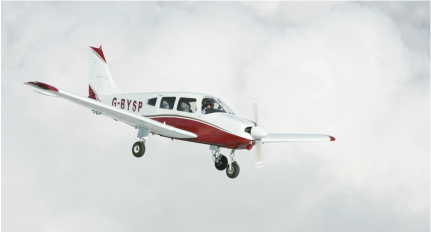
Take Flight Aviation owns a variety of aeroplanes, all based at its Wellesbourne Mountford home. We had originally been allocated Piper PA-28-161 Warrior G-BSCY but as the day of the flight approached &CY was approaching its 50hr check and we subsequently changed to Piper PA-28-181 Cherokee II G-BYSP. &Sierra Papa* was built in 1985 and imported to the UK from Germany in 1999. Powered by a 180hp Lycoming O-360-A4M engine turning a two-blade, fixed pitch Sensenich 76EM8S5-0-62 propeller the aircraft has an economical cruise of around 100kts.


According to the handbook the top speed is 148kts, the best rate of climb speed is 85kts and the stall speed (with full flap) is 54kts. Best rate of climb is 735ft/min and the take off ground roll is 870ft (265m). Fuel consumption at 75% power is quoted as 8.8 US Gal per hour (33.3 litres per hour). This power setting will give a 690nm range at a cruising altitude of 7,000ft. Fuel capacity is 50 US Gallons (189 litres).

The Cherokee II has a 35ft wingspan and a wing area of 170sq ft. Length is 23ft 9in and it stands 7ft 4in at the tail. The aeroplane has a wing loading of 15lb/sq ft and a power loading of 14.2lb/hp. The aeroplane*s empty weight is 1,413lb (641kg) and its gross weight is 2,550lb (1,157kg) giving a useful load of 1,137lb (516kg).

Sierra Papa and has around 7,500hrs &on the clock.* She is equipped with one VOR/DME, one ADF and two radios. It is equipped with an STEC autopilot but this was unserviceable during Dawn to Dusk and flagged as inoperative. We carried an Airbox Foresight Global Positioning System generously loaned by Airbox Aerospace especially for the Dawn to Dusk flight.

This new, state-of-the-art, GPS was recently launched to the market after 20,000 manhours of development by British company Airbox Aerospace. Based in Grove, Oxfordshire the company has produced this GPS to be as easy to use as possible and it comes in two versions 每 the Freedom Clarity with a 4.3in screen and the Foresight with a 7in screen.

※We*ve carried out exhaustive research on both the hardware and the software and I*m proud to say that we*ve created a product that many pilots have been crying out for,§ says William Moore, chief technical officer of Airbox. ※We set out to reduce pilot work load by simplifying the processes used to input data; icon-driven menu interfaces give the user vital seconds to focus on the greater job in hand; that of actually flying the aircraft.§ Airbox*s chosen touch-screen design allows pilots to very quickly enter a destination and fly there on the very latest 1:500,000 UK digital CAA charts which come standard with system. Users can touch the map to divert their current route if warned of an approaching airspace. At the point of a finger, airfield and airspace information can be instantly recalled, whilst future additions to the software will include NOTAMs and weather information.

Sponsors

As in previous years Amanda and I have been very lucky to receive sponsorship to enable to us to enter the Dawn to Dusk contest. In addition to Take Flight Aviation, who provided the aeroplane and fuel, we are indebted to Flightworx Aviation for logistical support, Pooleys Flight Equipment for the provision of maps and charts, Airbox for the generous loan of an Airbox Foresight GPS, the Charlecote Pheasant for providing free accommodation and The Will Turner Logs for additional funding.

Timing

As this flight was being conducted to gain publicity and exposure for fly2help we needed to give media outlets as much notice as possible prior to the day of the flight. This, we hoped, would give sufficient time for journalists and photographers to be assigned to the story.

However, with Dawn to Dusk competition*s August 11 deadline rapidly approaching the clock was well and truly &ticking*. Fortunately during discussions with a fellow competitor it was suggested to us that the 2009 deadline had been extended to the end of August and an e-mail to the organisers* office confirmed this. Nevertheless we still had less than five weeks to plan and instigate the flight...


We decided to allocate a weeklong weather &window* in order to give the press something to plan towards and based upon our calculations and discussions with weather &guru* Simon Keeling at Flying High Weather it appeared that the week commencing August 10th would be the week to plan for... this was just three weeks away!

21st Century Updates

As we were doing this Dawn to Dusk flight on behalf of charity we expected there to be a significant amount of interest in the project. We therefore took an early decision to create a dedicated webpage on my Awyr Aviation website to provide people with the latest updates.

Operations Manager

John Baker would also update the site with our progress during the flight itself. Regular updates were also posted on the social networking website Facebook and this generated a number of leads and useful contacts 每 especially when trying to obtain permission to visit various airfields.

Planning

As Amanda lives in Oxfordshire and I live in Nottinghamshire we do get to see each other very often so during the planning process we spent many hours on the telephone discussing ideas, creating and amending lists and drawing lines on maps 每 our lines were drawn 150 miles apart but in perfect synchronisation! When planning our last entry into the Dawn to Dusk contest we had been able to narrow down our list of &target* airfields very easily 每 the King*s Cup had been held at 26 airfields and only 17 of them were still airfields in 2007. However, for a theme as diverse as the Airshow Centenary we could not be so precise. If one looks into the history books almost every airfield has played host to a show, open day, family day, fly-in or gathering at some point during its life. Even London*s Gatwick has been an airshow venue in the not too distant past. As such we would not be able to define our route so easily.

We therefore began the planning process by creating a list of &obvious* and &must have* venues that spring instantly to mind when speaking of airshows. The big venues such as Farnborough, Biggin Hill, Fairford, Duxford, Coventry and North Weald were the first to be committed to paper and the list continued to grow.

The first British airshows took place at the racecourses at Doncaster and Blackpool in 1909 so it was vital that we included both cities in our list. Of course Blackpool has gone on to host a multitude of airshows over the years and Doncaster*s RAF Finningley (now Doncaster Sheffield Robin Hood Airport) was the venue to countless memorable Battle of Britain At Home Day airshows during its RAF career. With these &essential* airfields drawn onto the map we found the best plan was to draw lines between them and see which other airshow venues fell within range. It is amazing how many airshow venues, past and present can be found on a CAA chart...! We soon found ourselves with a map containing somewhere approaching 50 &target* aerodromes and seaside venues 每 so it became obvious that a radical rethink was necessary.

A &crisis meeting* was called in Oxford and a definitive wish list of venues compiled over a bottle of wine. This was then marked onto a 1:500,000 CAA chart and an action plan drawn up. We narrowed the list down to 30 airfields and set about developing the most efficient route around them. All landings would be &touch and goes* unless we required fuel or were scheduled to meet the press to promote the charity. Working on a maximum of four hours endurance 每 with 45 minutes reserve 每 a provisional route was planned using an average speed of 95kts. Although VFR rules call for just 30 minutes reserve we opted for 45 minutes to allow for various contingencies due to press commitments. As we expected to travel the length and breadth of the UK during the flight we reckoned that any headwinds we encountered on the day would be cancelled out by a tailwind at some point, so for the sake of planning we used nil wind at this stage. We also factored in 10 minutes to every leg to cover the approach, landing (or touch-and-go), takeoff and climb out. Where refuelling or press conference stops were scheduled we allowed ourselves 30 minutes on the ground. As we had learnt when planning our earlier entries into the Dawn to Dusk competition the first hurdle to overcome in any flight such as this is what to do during the early morning hours. Most airfields do not open until 09:00 (08:00 at best) so, assuming an 04:30 departure, the first four and a half hours can be difficult to fill.

Sunrise!

At this point our thoughts turned to our 2007 flight and the sinking feeling we felt when we realised that we (actually I*ll hold my hands up and admit it was me) had forgotten to check the official sunrise and sunset times. On that occasion we had planned our flight for June but delays meant we did not fly until July... by which time the sunrise was significantly later. This resulted in us sitting on a dark airfield for 30 minutes waiting to take off and subsequently missing the bowser at our first refuelling stop.

For this latest entry we planned to fly during the first two weeks in August 每 which gave us a sunrise time of around 05.40 and a sunset time of about 20.40. Working within the CAA*s permitted&sunrise/sunset +/- 30minutes* rules meant we could be airborne no earlier than 05.10 and would need to be on the ground by around 21.10... this giving us about an hour less flying than the Dawn to Dusk rules permit.

In order to find an airfield to visit very early in the morning we have found that it is often best to conduct a long distance trip north or south to begin the day, then land at 24 hour (H24) airfield for fuel before beginning to work back through the country. We had a number of options on this occasion with Doncaster opening 24/7 and the Isle of Man opening at 06.30.

As such the decision was made to contact all the airfields on our &hit list* and request permission to land, ideally with a waived landing in support of the fly2help charity. In order to collate the replies and plan the flight an Excel spreadsheet was created detailing the airfield, contact name, and contact telephone number/e-mail. Fields were included in the spreadsheet to note whether the airfield operators had replied to our messages, whether they had confirmed a free landing and whether they had offered any other assistance. The final column listed the airport*s normal operating hours. This spreadsheet ensured that all members of the team would have access to the information at any time and as such would be updated as soon as contact was made. It was updated when details changed and a fresh version e-mailed to the entire team once a day.

Plan A

With such a short timeframe to work within it was imperative that we started negotiations with our target airfields as a matter of urgency. In full knowledge that the route would change several times before the day of the competition we did not commit to dates, or even times, when approaching airfields and made it very obvious that we would not commit to visiting until much nearer the day itself.

Plan A, created during our &crisis meeting* in Oxford called for stops at the following airfields:
Depart Wellesbourne
Coventry ETA 05.50
RAF Waddington ETA 06.40
Durham Tees Valley ETA 07.50
Fuel & Press
Elvington ETA 09.10
Doncaster ETA 09.40
Blackpool ETA 10.40
Fuel & Press
Derby ETA 12.10
RAF Cosford ETA 12.40
Halfpenny Green ETA 12.55
RAF Fairford ETA 13.40
Sywell ETA 14.25
Fuel & Press
RAF Mildenhall ETA 15.40
Cambridge ETA 16.00
Duxford ETA 16.15
Fuel & Press
North Weald ETA 17.15
London City ETA 17.35
Biggin Hill ETA 17.55
Shoreham ETA 18.30
Fuel & Press
Farnborough ETA 19.30
Kemble ETA 20.15
RTB Wellesbourne ETA 20.50

This would give a total flying time of 12hrs 50mins and a distance of 834nm.

Initial contact was made with these airfields by means of an e-mail requesting permission to land. It also offered each airfield the chance to host a press conference to promote their support of the flight. A number of these airfields were very familiar and we have good friends at them. My contacts at the Imperial War Museum, particularly within the marketing team, were the first to respond with the offer of a press conference at Duxford. Esther Blaine was a tremendous help throughout the project.

Terry Holloway, Group Support Executive at Marshall Aerospace replied minutes later offering the use of Cambridge Airport, including a press conference if we desired.

The next response came from Tony Rowlands, FISO at Wolverhampton*s Halfpenny Green airport, advising us that he would waive all fees if we chose to land at the airport. It is perhaps worth mentioning that all three of these offers came within 30 minutes of sending the e-mail! However, things then started to dry up...

Over the course of the next few weeks a significant amount of time was expended trying to contact and negotiate with the &right* person at each airfield. We were often passed from &pillar to post* with little or no joy.

In 2007 we had benefited from the help from Tim Fenton, Operations Manager at Durham Tees Valley, but he had sadly moved on to pastures new along with most of the marketing team. The airports public relations work was now carried out by Peel Holdings HQ at Liverpool who sadly did not see the potential in a Dawn to Dusk visit. We also struggled to find a useful contact at RAF Waddington and Doncaster Sheffield Robin Hood Airport (formerly RAF Finningley) was also proving problematical. Flying north in the morning was clearly a none-starter and it was obvious that a radical rethink was on the cards...

Radical Rethink

I was sitting in a friend*s garden near White Waltham on a sunny Saturday morning when the idea struck me. An Emeraude flew overhead and my thoughts turned to my old friend Neil Harris who owned similar machine and still owed me a flight in it. Neil used to work in the tower at East Midlands Airport and had been my duty controller when I organised the Today*s Pilot Fly-In at Tollerton. He*d then moved onto Heathrow but he had recently taken over the control tower at Newquay Airport...

Newquay had held countless airshows in its days as RAF St Mawgan so I didn*t waste a moment and was on the phone to Neil while the Emeraude was still within ear-shot. He was only too happy to help the project, informed me that they were generally open at 06.30 and that he would ensure any fees were waived. So the decision was made, we*d head south to start our flight and then work northwards during the day. Later than day I also received a call from Ed Swain, organiser of the Isle of Man TT Races. Ed had been helping research my airshow book and he suggested that we might like to consider flying to the island during Dawn to Dusk. He had good contacts on the island and assured us we*d be well looked after... how could we refuse?

Plan B

Trying to work both Newquay and the Isle of Man into the trip proved trickier than first thought but we re-issued a provisional route on July 28. We were also unsure if we could depart Wellesbourne&out of hours* so we planned to start from Coventry airport (having positioned the aeroplane from Wellesbourne the previous evening). This version of the plan read as follows:


Depart Coventry
Isle of Man ETA 07.00
Fuel & Press
Blackpool ETA 08.20
Fuel & Press
Doncaster ETA 09.50
Derby ETA 10.30
Fuel & Press
Stoke Golding ETA 11.20
Sywell ETA 11.50
Fuel & Press
Old Warden ETA 12.40
Cambridge ETA 13.00
Mildenhall ETA 13.20
Duxford ETA 13.40
Press & Fuel
North Weald ETA 14.40
London City ETA 15.00
Biggin Hill ETA 15.20
Farnborough ETA 15.50
Newquay ETA 17.50
Press & Fuel
Kemble ETA 19.10
Press (No Fuel)
Birmingham ETA 20.30
Press (No Fuel)
RTB Wellesbourne ETA 21.20

This route would result in 12hrs 20mins airborne and a total distance flown of 819nm. Over the coming weeks the route evolved somewhat as more airfields confirmed their level of support. At this point Adrian Kinsley also joined the team and instantly proved to be a tremendous asset. Adrian is currently studying to be a commercial pilot and working in the Flight Operations office at Flightworx.

During his ※long and boring§ night shifts he took it upon himself to try to get permission for our Dawn to Dusk flight to land at as many airfields as possible. Using his network of handling agents around the country he quickly got the necessary authorisation to visit Biggin Hill, Doncaster and Farnborough! He also made several calls to London City Airport on our behalf.

Landing at London City in a single-engined Piper PA-28 was always a long-shot but to their credit they looked into every possible angle to try and make it viable. Sadly red tape defeated us in the end as neither the aeroplane nor the crew were checked out for the 5∼ glide slope required to land at the Docklands airport.

We had hoped to land at London City as their annual Fun Day is one of the most unusual airshow venues in the country. The event takes place on behalf of charity and the 2009 event, which took place on July 4, raised £41,644.91 for the Richard House Children*s Hospice.


Sue Kendrick at Blackpool Airport has always been a strong supporter of my Dawn to Dusk exploits and goes out of her way to help. As Blackpool was the venue of Britain*s first &official* airshow we felt confident that they would want to play a major role in the flight. However, it transpired that the airport is planning its own celebration in October and Sue decided not to schedule a press conference to coincide with our flight. She did waive landing fees for a touch and go however and invited us to fly in again during the main commemoration later in the year.
Whilst this did mean we would miss the press conference at Blackpool it did mean that we had 30 minutes spare to stop off at Doncaster where Adrian*s hard work had paid off and we had been invited to hold a media photo call.

Call the Pentagon!

If London City had been a long-shot our hoped to land at both Mildenhall and Fairford 每 both active USAF bases 每 were even more remote. However, we are nothing if not persistent! A number of contacts were made to RAF Fairford, both through the airshow office and the base itself... there was no response.

RAF Mildenhall however was a different matter. I had visited the base earlier in the year on behalf of the Friends of Duxford organisation and had enjoyed lunch with Vicky Stayton, the 100th Air Refuelling Wing*s Public Relations Officer. I contacted Vicky who duly passed my e-mail along the chain to the powers-that-be.

To my surprise I received a telephone call from the base a day later and found myself speaking to Sqn Ldr Rick Fryer, Mildenhall*s RAF Commander. Over the coming weeks Sqn Ldr Fryer proved to be one of the most helpful people I have ever dealt with and worked wonders behind the scenes to make our wish come true. Sure enough, on July 30, he forwarded me the forms to sign to apply for Pentagon clearance to land on the base (which is classed as US territory).

We received our permission a few days later 每 but only to perform a &roller* - and Sqn Ldr Fryer apologised for the USAF*s bureaucratic red tape. I did explain that, in fairness, the USAF had been far more accommodating that the RAF who had not bothered to even respond to our requests to land at Waddington or Cosford!

I was eventually able to contact RAF Fairford too. A &friend of a friend* passed me the private e-mail address of the base*s RAF Commander, Sqn Ldr Tony Maycock.

Sqn Ldr Maycock called me almost straight and away to learn more. I was mid way through explaining what the Dawn to Dusk contest entailed when he stopped me in my track... ※I knew I*d heard your name somewhere before!§ he exclaimed. ※I saw you lecture about Dawn to Dusk at the Lyneham Flying Club!§ He put me on hold and within three minutes he had obtained permission for us to do a &low approach and go around* at Fairford as long as we didn*t touch down.

Sqn Ldr Maycock even offered to arrange for staff to come in especially to man the tower if we needed to visit out of hours. Both Sqn Ldr*s Fryer and Maycock are both active private pilots and I think that was what inspired them to go beyond the call of duty to help enable us to visit their bases每 despite the USAF red tape and headaches that this undoubtedly caused them.

An approach had also been made to the Royal Navy to enquire whether it would be possible to perform touch and goes at both Yeovilton and Culdrose en route to Newquay. Unfortunately we were informed that the Navy was effectively ※shutting down§ for the month of August and they would not be able to assist.

Full house

As the final weeks progressed our routing began to firm up as more and more airfields signed up to support us. Tim Jinks, the owner of Stoke Golding airfield in Warwickshire (venue to the small put popular Stoke Golding Stake Out event) not only agreed the use of his airfield but also offered to formate on us and escort us in with his new Christen Eagle biplane. Our old friends at Derby also agreed to have us back as did Damyns Hall, Sywell and the Shuttleworth Collection at Old Warden. Little Gransden (home to the Children in Need airshow) also extended an invitation to visit as did the former Red Arrows base at Little Rissington 每 the latter allowing an out of hours landing.

Our route from Farnborough to Newquay took us very close to the little airfield at Branscombe in Devon - itself a small but growing airshow venue- and a call to the airfield owner resulted in an invitation to overfly it. Sadly he wasn*t able to let us land as the number of movements at the site is restricted but he did offer to accommodate us in the future if we gave more notice. Tony Rowlands at Halfpenny Green was keen for us to include the airport in our list but the only time we could fit it into our schedule was very early in the morning (around 05.30). He graciously agreed to allow us to land out of hours and we signed an indemnity form to make it fully legal.

We were also granted permission to depart out of hours from Take Flight Aviation*s home base at Wellesbourne Mountford. This was fortunate as Coventry had recently changed their operating hours and they were not prepared to let us depart there before 08.00... With a little re-jigging of the route we were able to move Coventry to 11.00 and use it as a refuelling stop. This would also negate the need to refuel at Derby and depart a 600m grass strip with a heavy load of fuel, so there was a large sigh of relief from the entire team! My connections at Air Atlantique put me in contact with Chris Wild, Operations Manager, who kindly agreed to have a bowser on standby for our arrival at Coventry. We allowed ourselves just 15 minutes from landing to take off to get uplift the 140 litres of fuel we figured we would need at that point... it was going to be tight!

&Go* Date

The media needed at least five working days to mobilise so by early August thought was being given to the date of the flight. On August 5 Amanda and I were invited to give a presentation to the club members of Take Flight Aviation to explain why were taking one of their aeroplanes away for a whole day! We got to Wellesbourne Mountford mid afternoon and sat down together to do some fine tuning to the plan. It was at this stage that Simon Keeling called to discuss the weather... ※The latter half of next week looks better than the first half§ he advised, ※I*d suggest you go for Thursday 13th or Friday 14th, there doesn*t seem to be any real difference between the two days at the moment.§

Amanda and I debated this for a while before speaking to Take Flight Owner Mike Roberts to see if he had any preference. We ultimately decided to opt for the Friday because it gave us an extra day to plan and allowed us to have the weekend to recover afterwards!

The date was set and the team were contacted. The aeroplane was booked and Mandy at fly2help was advised. We then began contacting the press and distributing the pre-prepared press releases and images. We had just nine days to finalise plans and prepare for the flight...

The Final Plan

By the time the various minor and major tweaks had been implemented we were up to Version 10 of the route. Having a definitive date enabled us to work out a precise sunrise and sunset time 每 which on Friday August 14 was schedule to be 05.37 and 20.32. The CAA rules allow a pilot to take off 30 minutes either side of sunrise and sunset 每 meaning we could be airborne at 05.07 and must be on the ground no later than 21.02. Both of these times fell within the 04.30-21.30 rules of the Dawn to Dusk contest so we aimed for an 05.15 departure from Wellesbourne.

The latest &re-jigging* of the programme resulted in a small amount of &spare* time at the end of the day so we planned to overfly the disused aerodromes at Upper Heyford and Gaydon (both once famous airshow venues) en route home to Wellesbourne. Version 10 of the plan was issued to the team on August 11 as part of the Daily Update e-mail that was sent round in the run up to the flight. It reads as follows:

Depart Wellesbourne ETD 05.15
Halfpenny Green ETA 05.30
Isle of Man ETA 07.15
Fuel & Press
Blackpool ETA 08.30
Doncaster ETA 09.25
Press (No Fuel)
Derby ETA 10.25
Stoke Golding ETA 10.45
Coventry ETA 11.00
Fuel (No Press)
Sywell ETA 11.40
Old Warden ETA 12.05
Little Gransden ETA 12.20
RAF Mildenhall ETA 12.45
Cambridge ETA 13.00
Duxford ETA 13.15
Fuel & Press
North Weald ETA 14.10
Damyns Hall ETA 14.25
Biggin Hill ETA 14.40
Farnborough ETA 15.05
Branscombe ETA 16.15 (overflight only)
Newquay ETA 17.10
Fuel & Press
Kemble ETA 19.15
Press (No Fuel)
Fairford ETA 20.00 (low approach only)
Little Rissington ETA 20.10
Upper Heyford ETA 20.25 (overflight only)
Gaydon ETA 20.40 (overflight only)
RTB Wellesbourne ETA 20.50

With a final &definitive* route to hand we then created LOGs for each leg of the flight, in an attempt to keep cockpit management as simple and efficient as ever. Each PLOG was printed on an A4 sheet of paper and showed the waypoints along the route and the distances between them along with the minimum safety altitudes and planned altitudes. The PLOG also contained the frequencies for every ATC unit we were likely to encounter on that leg along with any nav aids we might find of use. Finally a list of useful telephone numbers included our point of contact at the previous, current and next airfield along with anything else of relevance.

Copies were e-mailed to Ops Manager John Baker and two copies were printed for the aircraft 每 one copy in yellow to aid Amanda*s dyslexia.

Final Run Through

On Wednesday August 12 Amada and I met in Oxford to &fly* the route for the first time. With 1:500,000 CAA charts laid out on table we talked our way around the route, discussing the various ATC units we would call and landmarks we expected to see en route. This was a tremendous help as it enabled us to prepare for the flight and understand what each other was expecting to do.

Discussions (lively at times!) more often than not centred around which frequencies to call when and what we would 每 or wouldn*t 每 be able to see when transiting a certain area. We decided to use a &call and response* system for all of our cockpit drills and checks. With fatigue an issue we wanted to ensure we didn*t leave any check incomplete or miss anything vital. Amanda and I fly a lot together, so we know what the other is likely to do or expect in the cockpit. But on this occasion we did not want to take any chances. This would be a multi-crew flight with both pilots in command.

All checks would be read out loud and acknowledged by the other person... without fail. During the day we also spent time with a journalist and photographer from the Oxford Mail and conducted a number of other telephone interviews with the press. We had issued press releases and photographs from our previous flights to the aviation press as well as assorted newspapers and media outlets along our expected route. A number of our destination airfields had also contacted the press and as the day approached it was evident that there was a lot of interest in our little project.

Record Setters?

As a result of her air racing background Amanda is in contact with various officials from the Royal Aero Club. She approached the RAeC*s record co-ordinator Geoffrey Boot and enquired whether it would be possible to use our Dawn to Dusk flight to establish one or more UK National Speed Records... Ever since she started racing she had wanted to set a speed record and it appeared this would be the ideal opportunity to do so she registered our intention to compete. Each record attempt would need to be ratified by the F谷d谷ration A谷ronautique Internationale (FAI) and paperwork would have to be signed at our departure and arrival point. This ruled out records at any of our touch and go stops, but we had plenty of fuel or press conference stops to choose from.

It was decided to make an attempt at the speed record from the Isle of Man to Doncaster, Duxford to Newquay and Newquay to Kemble and the FAI agreed to consider each of these records. Whilst we recognised that we would not set a very competitive speed (especially as we were not flying direct between the two points) we felt that the record attempts would help us gain even further publicity for fly2help. There were no existing records in place for these routes 每 so all we had to do was complete the flight to set the record! Amanda would have to log these flights though, as she was the only one of us with a racing licence.

When we normally fly Dawn to Dusk we split the legs between us with one person logging the takeoff and the other logging the landing 每 this means we both get each airfield in our logbook and the flying hours generally work out evenly. However if Amanda was going to log these long distance legs it would have left me with lots of landing but very little flying time so we broke with convention and decided that Amanda would log the record flights and I would log the rest of the time.

Continued . . .